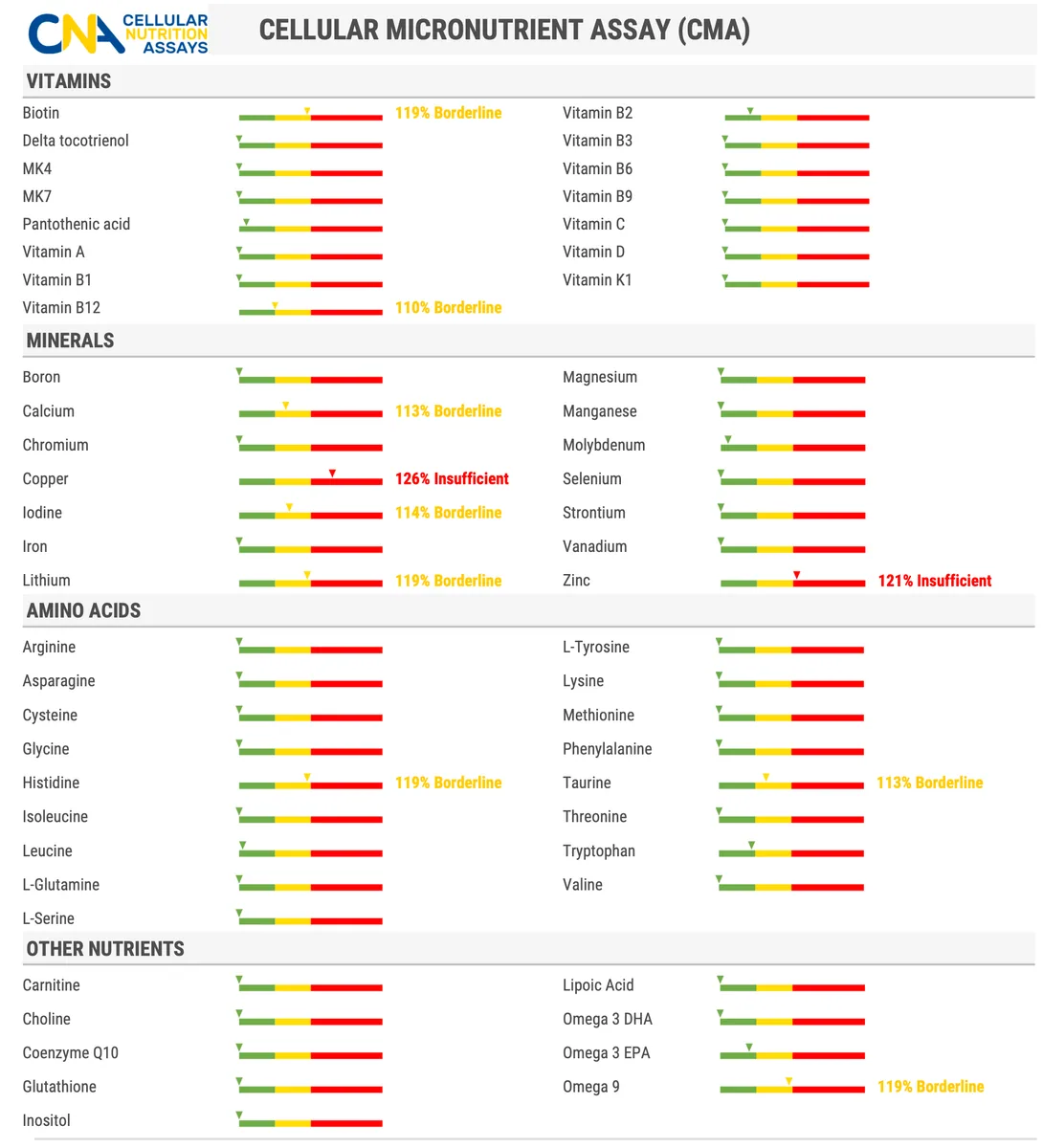
Start with your original CMA report: check its date, values, and the lab’s categories. Several low amino acids may raise questions about protein intake or absorption; antioxidant findings may lead to other questions. A flagged result starts a conversation. It does not explain your symptoms by itself.
Putting the pieces together
Your plan may set priorities, avoid doubling up on ingredients, and track food intake and tolerance. Dr. Purser sometimes uses an approximately 100-day replenishment period with a check-in around ten weeks. Your progress may take a different course, so agree on what to track and when to review it.
A question to bring to your visit
What is the first priority, what will I track, and when will we decide whether the plan is helping?
Reading your own results
Bring your original report, current results, health history, and medicines to your visit. This information can help you ask questions, but it cannot diagnose a condition or choose a supplement dose for you.
EXPLORE WITH YOUR CARE TEAM
Supplements to explore
Compare the products below, including their ingredients and available forms. Your care team can help you choose one or more options for your needs.
Hi everyone, Jackson Larkin here from Purser Wellness. If you’ve had our Cellular Micronutrient Assay (CMA) with Redox testing, chances are you’ve looked at those two pages of results and thought, “Okay... now what does all this actually mean?” You’re not alone. This is one of the questions I hear most often from patients. Let me walk you through exactly what each page shows, how the test works, and why these results are so powerful for creating a truly personalized plan to help you feel your best. How the CMA with Redox Test Actually Works The magic happens at the cellular level. From a simpl
🔬 What is VARS? Why the VARS Trio (Glutathione + SOD + Catalase) is a game-changer for inflammation, recovery & fibromyalgia.
Jackson Larkin sits down with Lois Schweiger to break down Dr. Dan Purser MD’s VARS line — Validated, Absorbable, Reduced, and Stable antioxidants. Learn the science behind VARS Glutathione, VARS SOD (from deep-sea algae near volcanic vents), and the newest VARS Catalase (Nrf2 activator from seaweed).
Discover:
• How the VARS Triad works together in the mitochondria to fight oxidative stress and cytokines
• Why Catalase dramatically improved post-workout recovery (especially leg day!)
• Genetics, homocysteine, PEMT, and why many with fibro benefit from this protocol
• The importance of CMA (intracellular) testing and when to retest
• Real patient results, including severe inflammation cases
Perfect for anyone dealing with chronic pain, inflammation, slow recovery, or looking for root-cause support.
**June Anniversary Special**: $100 off Genetic + CMA testing — one order will be fully reimbursed!
👉 Learn more & shop VARS supplements: danpursermd.com
#VARSGlutathione #Fibromyalgia #Antioxidants #ChronicInflammation #PurserWellness #Catalase #SOD
Timestamps:
00:00 Intro & What Does VARS Mean?
01:45 The Science of the VARS Triad
12:00 Who Needs the Trio?
14:00 Catalase & Workout Recovery Stories
20:00 Genetics, Homocysteine & Testing
Follow Dr. Purser!
Info: http://www.DanPurserMD.com
Supplements: https://www.PhysicianDesigned.com
Books: https://www.amazon.com/-/e/B00BIKSGVQ
Facebook: https://www.facebook.com/danpursermd
Facebook: https://www.facebook.com/PhysicianDesigned
Twitter: https://twitter.com/realdanpursermd
YouTube: https://www.youtube.com/danpursermd
Instagram: https://www.instagram.com/danpurser.md
Pinterest: https://www.pinterest.com/danpursermd
Ever looked at your CMA with Redox results and felt confused by the two pages? I just broke it down simply — what each page actually measures, why “highly protective” on the antioxidant page is a deficiency signal, and how we turn it into y